


This is the first morning I wake up without Haubi.
For ten years, this old Mercedes truck was my home. My vehicle for freedom and autonomy. Turn the key and keep moving. Don’t like the place? Move on.
I could reach places — and did — that most people can only dream of. Park somewhere in the middle of nature, open the door, and be right inside it.
But freedom always has another side. I had to take care of things. Where can I stay tonight? Do I have enough water? Where can I do my laundry? What urgently needs fixing on Haubi? How much will it cost? And what the hell is that noise now?
Entropy gets to old trucks, too.
Haubi cost money. But more importantly, he required something we talk about much less: attention.
Yesterday, I sold him. Contract signed, money in my account, keys and papers handed over. Ten years of my life changed hands.
And this morning I ask myself: What do I miss?
The honest answer surprises me: nothing.
The first feeling that comes up is something else: free and unbound.
I was free with Haubi, too. But unbound feels different. Something that occupied part of my energy and attention for ten years is suddenly no longer there.
And it’s precisely this space that interests me.
Between the old and the new
In his book Transitions, William Bridges makes a distinction I find useful. Change is what happens on the outside: a job ends, a relationship breaks apart, a child moves out, someone dies, we move to another city — or we sell the truck we have lived in for ten years.
Transition is what happens inside us.
Bridges describes three phases:
- Ending — something ends.
- Neutral Zone — the old is gone, but the new has not yet arrived.
- New Beginning — something new begins.
I am pretty much right in the middle. Haubi is gone, but the new?
I have no idea.
Maybe you know this place. Maybe a relationship has just ended. A job that had become part of your identity. Your children suddenly need you less. You made a decision you cannot undo. Or perhaps you simply sense that one version of your life is over without knowing what the next one will look like.
You know what no longer is, but you don’t yet know what will be.
And that’s where things get interesting.
Our minds hate empty spaces
As soon as an ending becomes real, the mind seems to start searching for new certainty. I can almost watch it happening in real time:
Is the sale really finished? Was I fair? Did I forget anything? Will the buyer keep calling me? What comes next?
One thought creates another. One becomes two, two become three, and suddenly we are no longer here. We are sitting somewhere in a future that exists entirely inside our heads.
Maybe you know your own version: Was ending the relationship really the right decision? Should I have stayed? What am I going to do without this job? What if I never meet anyone again? What should I have done differently?
Attention gets magnetically pulled into thought, and inside our heads we begin constructing a world of questions, scenarios, and apparent solutions.
But there is something we easily overlook:
Attention is finite. Wherever it goes, something else disappears from view.
If all of it is occupied with trying to make an uncertain future feel certain, it is no longer available for what is actually happening right now.
The old oak tree
This morning, the first thing I notice is a subtle restlessness. Almost like a movement inside me before there is even a clear thought. As if the ground that was there yesterday has suddenly disappeared.
So I check.
The ground is still there. Quite literally.
I go outside. Movement is often my tool of choice — adding an outer movement to the inner one. Not to get rid of anything, but to give whatever is there some room.
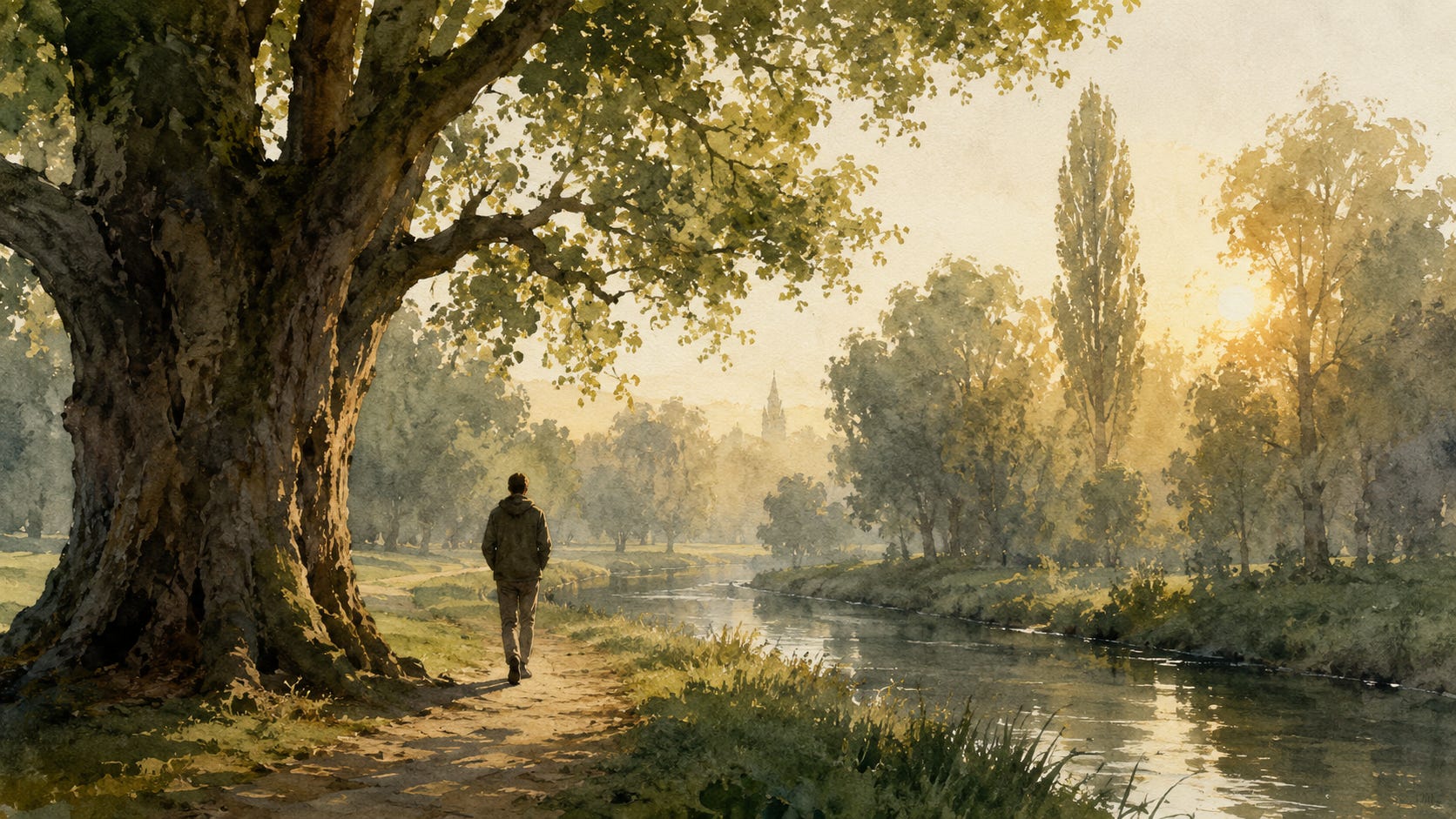
I open Google Maps, see a park nearby and start walking. It’s still early, the air pleasantly cool. After a few turns through the streets of Berlin, I reach the park and almost immediately my mind becomes wider.
Green. Water. A small stream winding through the park. I look it up: the Panke.
A little farther on, I stop in front of an old oak tree. It is enormous, its trunk thick and deeply furrowed. I wonder how long this tree has been standing here, how many things around it have appeared and disappeared again.
For a while, I can’t take my eyes off it. I’m simply there.
My inner landscape suddenly feels like a mixture of everything is new and how beautiful this is.
Maybe this is something we easily miss during transitions: while we are busy trying to figure out what comes next, we miss the space that has opened precisely because something is no longer there.
Not every thought is the enemy
Of course, the thoughts still return.
Did I really do everything I could? Was I fair? Did I hide anything?
But this time, I don’t try to get rid of them. I look at them more like I looked at the Panke or the old oak.
There is a thought. Okay. What can I learn from it?
Maybe it is simply an invitation to take one final inventory:
Did I give the buyer all the information I had? Yes.
Did I hide any problems? No.
Did I take the time to explain Haubi to him? Yes.
Is there anything left that I should actually do?
If the answer to that last question is yes, I can act. If the answer is no, another possibility opens up: I don’t have to produce another fifty thoughts just to get rid of the feeling of uncertainty.
Maybe uncertainty can simply be uncertainty.
Pema Chödrön writes in When Things Fall Apart about this experience — those moments when the ground seems to disappear beneath us and there is nothing left to hold on to.
Our usual response is to rebuild solid ground as quickly as possible: plans, explanations, certainties, new goals.
But what if, for a moment, we didn’t?
What if this moment could simply be enough for the next five minutes?
The price of closeness
Over the past few weeks, I have also found myself thinking about Robert Pirsig’s Zen and the Art of Motorcycle Maintenance.
Pirsig’s motorcycle is not merely a machine. The way he pays attention to it, the way he tries to understand how its individual parts work together, becomes an expression of a particular relationship with the world.
For Pirsig, care and quality are closely connected:
“A person who sees Quality and feels it as he works is a person who cares.”
That idea touches something I experienced with Haubi. When you spend ten years with a machine, it eventually stops being just an object. You know its sounds, its quirks, its weak spots. You know when something feels right and when something doesn’t.
You care.
Maybe you don’t know this from a machine. Maybe you know it from a person, an animal, a house, a city, your work. We build relationships, and the more deeply we allow ourselves to enter them, the more vulnerable we become.
Because none of them will remain forever.
At first, that sounds like the bad news. But maybe it is exactly the other way around.
We could try to keep life at a distance. Not get too involved. Not love too much. Not become attached. Maybe then saying goodbye would hurt less.
But what would we have gained?
If I feel grief about Haubi today, it doesn’t tell me that something went wrong. It tells me something much simpler:
It mattered.
There was relationship. There was closeness. There was life.
Grief, then, is not evidence against a good life. It may simply be one of its consequences.
At the same time, there is something Pema Chödrön returns to again and again: beneath all our constructions lies uncertainty. We don’t know how long something will remain, how a relationship will end, whether a plan will work, or what will happen tomorrow.
Maybe this groundlessness is not a flaw in the system.
Maybe it is the condition that allows something new to emerge at all.
The field after harvest
The image that comes to mind is a field after harvest. The old crop is gone. The new one has not yet been planted.
From the outside, not much seems to be happening, but that empty space is not meaningless. Maybe we make a mistake when we try to plant it again immediately.
The Neutral Zone is not just the annoying stretch of road between two important destinations.
Maybe it is an important destination in itself.
A place where attention becomes available again. A place where we can watch old habits trying to reclaim the newly opened space. And perhaps a place where parts of our inner landscape become visible that were previously hidden beneath tasks, routines, and certainty.
The next time something small or large ends in your own life, you might experiment with this.
When you notice your mind immediately trying to fill the space that has opened, stop for a moment. Not to get rid of your thoughts, but to examine them.
Ask yourself:
What has actually happened?
Is there anything I can or should do about it right now?
If yes: what is the next simple step?
If no: can this moment be enough for the next five minutes?
Then bring your attention to something that does not exist only inside your head: the ground beneath your feet, your breath, a tree outside the window, the sound of the street. Whatever is actually here.
Not as a trick to make uncertainty disappear, but to discover that perhaps you don’t have to make it disappear at all.
What this has to do with sovereignty
In the end, I find myself returning to something I think about again and again: dependency and sovereignty.
For me, dependency does not begin with a visible action. It starts much earlier, perhaps with that tiny movement of the mind toward habit and apparent certainty.
A thought appears. I believe it. Another one appears. I follow it. And another.
Until all of my attention is tied up there.
Sovereignty does not mean never being afraid, never grieving, never doubting — and certainly not never having thoughts.
Maybe it means something much simpler:
Being able to notice where my attention is going without having to follow every impulse.
Sometimes there really is something to do. Then I do it.
And sometimes there is nothing left to solve.
Then there is uncertainty. An open space. The Panke. An old oak tree.
And perhaps, for a moment, the realization:
Impermanence doesn’t only take something away. It also sets something free.
Attention. Energy. Possibility.
Sometimes even a version of ourselves we haven’t met yet.
Today, I still don’t know what comes next.
And for the first time in a long time, that doesn’t feel like a problem.