


Wild & Simple - Stories from an ordinary life, where chocolate and chili dance together.
Dear reader,
it is Sunday afternoon, 3:47. For three months I have sent out my newsletter at this hour. Not today, and not last Sunday either. There is a sentence in my notes that I can’t get past:
I don’t think I have ever in my life allowed myself even half a year of simply being happy and at peace. Never.
As I read it, sadness rises in me. How does a day feel when nothing has to be done? And who am I then?
I have no answer to present to you. All I have is this moment. Come with me, let’s walk a little way through the garden. I follow no outline, only what shows itself, a kind of inner north star. Here and there I sit down on a bench and look more closely. I don’t fetch any facts from outside. My only tools are my mind and my attention.
The Gate: A Gun to My Chest
In June I decided to publish a newsletter every Sunday for a whole year. What dynamic brought me there, I didn’t know at the time. It felt reasonable, almost obvious. I read it everywhere:
You have to be present, every day, every week, or nobody sees you.
Since then I sit every week with a homemade gun pressed to my chest, and it says: “Come on, write. Think of something.”
Nobody built it but me. There was no client, no contract and no reader who asked for it. The pressure is real all the same and my body notices first. I am feeling under the weather, and it keeps sending the same signal: please take the pressure off.
What amazes me is how often I have already written about having to. I know it, I have examined it and put it aside, and still it holds the strings in my mind, quietly. It comes back a little quieter every time, and a little friendlier. That is exactly what I want to get to the bottom of today.
The First Bench: What “I Have To” Promises
I sit down and ask: what does “I have to” promise me if I follow it?
The answer comes fast. It promises recognition, and it comes from outside. The mind turns discipline into a then. If you write every week for a year, then you can be proud. Then you’ve made it. Then you’ve achieved something. Then, someday, in the future.
This then is a lie. The thinking mind built it out of something that was at first only energy in motion.
I know it from my whole life. When I have the certificate as an outdoor trainer and experiential educator, then I’ve arrived. I got it, and I hadn’t arrived. When I finish the triathlon, then I’m somebody. I ran the ten kilometers at the end, crossed the finish line and rode the Cyclassics bike race several times over, and the happiness didn’t stay. When I have the right relationship, then I’ll be happy. I had more money, and I had less money, and neither one stilled the hunger. And when is a person an artist? After the first published piece? After the hundredth? The then moves one step further away every time I come closer.
Successes like these never brought me lasting peace, a short moment at most, and afterwards I needed the next one.
Something else stands out. I almost always set my goals far too high: every Sunday for a whole year, without a single exception. Why would anyone unconsciously set a goal they can’t possibly reach? I don’t know. Maybe it is an invitation from the soul to come home again.
When I slow down and turn the inner spotlight on what is here, everything slows down with me. Something that looked solid and believable a moment ago suddenly opens like a water lily. Picture it like this: you missed the whole birth of the dynamic. You only wake up inside the finished structures and take them for reality, without ever questioning them.
A Detour
Here I stop for the day. The next morning I read what I wrote and notice that I am starting from a point where I no longer am. Today is a new day with a new energy, and as always I can only write from what is alive now.
So I ask: what is alive today?
Now I allow it. I listen for what has energy, what moves and how it feels in the nervous system. I don’t have to write. It happens freely, because my soul delights in expressing itself, like wind that blows because that is its nature. I am not after anything and I don’t want to become someone who explains everything. I want to report, to show, to share and maybe to point at something.
The Flowerbed: Where “I Have To” Begins
“I have to” is a thought, and beneath every thought lies something. Sometimes it is a real need. “I have to go to the bathroom” is a thought that does its job. The body needs something, and the thought helps.
When I shut out the outside and wait to see what appears by itself, I watch the same thing happen every time. First something in me scans the basics. Do I have a roof over my head? Am I safe? Is there food? Does anything need doing today? When the answers come back good, my nervous system relaxes.
Then something strange happens. Although everything is there, the mind starts to search. It keeps scanning, as if something were missing. We have learned that simply being is not enough, and that program keeps running even when the roof is tight and the plate is full.
Nobody is searching. It is an energetic movement of the mind, much like hunger. Fritz Perls wrote a whole book about hunger. This hunger, though, can’t be stilled by any essay or any subscriber count.
The Meadow
Long before it becomes the sentence “I have to”, this movement is already there. It doesn’t sit in the body. It lives in the mind, and the mind comes before the body and is larger than it.
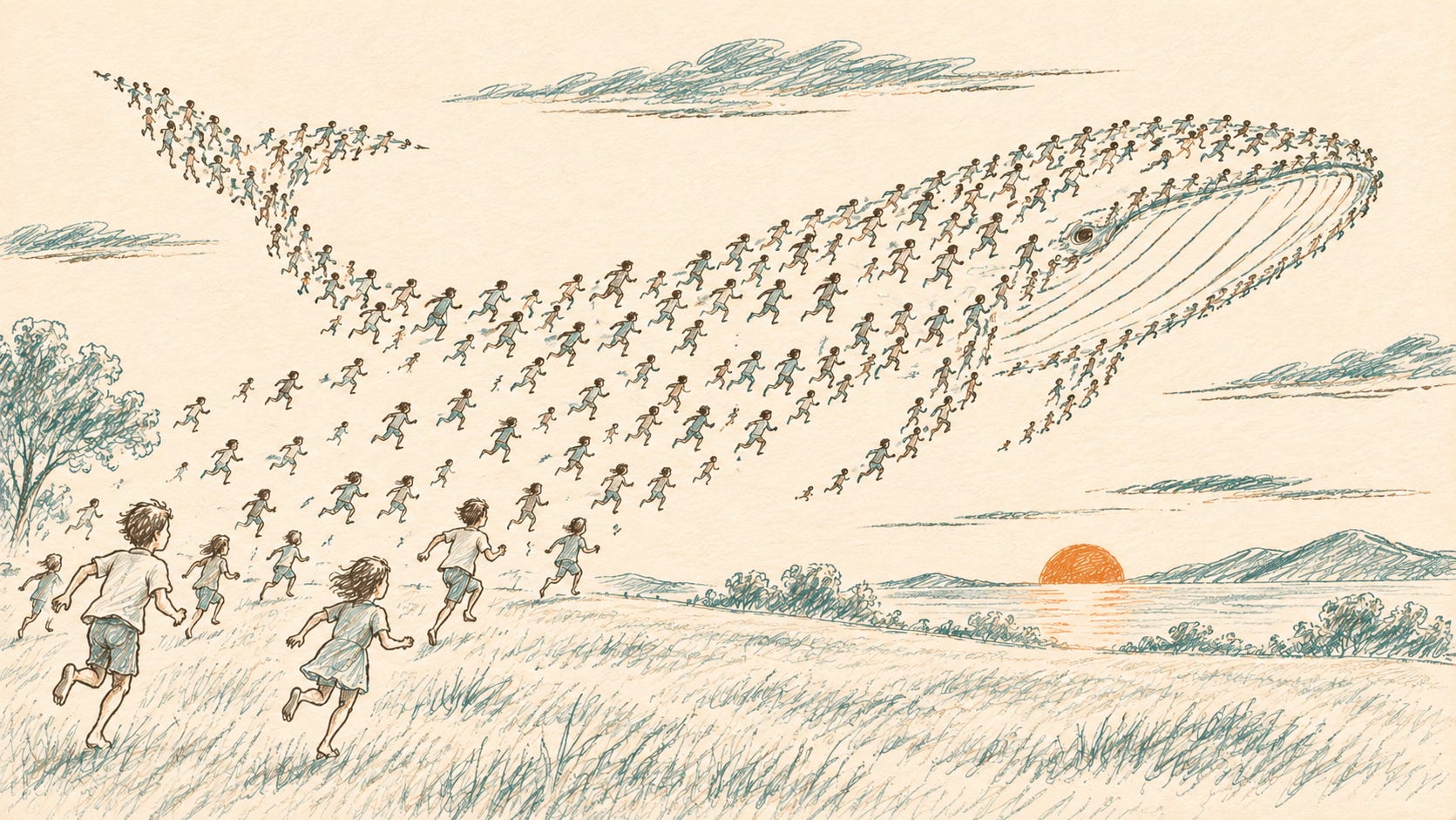
Picture a meadow. It isn’t empty. Hundreds of small children are running across it, wild and every which way, like at break time in a schoolyard. Each one feels a little alone as it runs. All of them long to belong together, and at the same time each wants to stay itself. Out of this comes tension, friction and energy.
At the edge of the meadow a teacher stands and watches. As long as he looks, the children stay single children who run, bump into each other and laugh.
Then the teacher looks away. In that very moment the children run together and become one single large figure, the way a thousand small fish swim close together and suddenly look like a whale. The energy of this figure is so strong that it lands in the body, in the nervous system, and you think: this is me. And because it is you, you have to be it. This figure has to write, deliver and be on time every Sunday.
So it moves out into the world until its time is up and the whole construction dissolves again. Most of the time I only wake up when the whale is already swimming.
The Second Bench: Noticing
What happens in the moment I notice that I have built myself a hamster wheel again?
First I feel ashamed. Then I grow sad, because it happened again, after everything I know.
After that comes something I can’t do. I can only admit it, as in the first step of Alcoholics Anonymous:
I admit that I am powerless over the thought “I have to”, and that I can’t manage my life this way.
And in the second:
I come to believe that a power greater than myself can restore me to sanity.
AA says “God as we understood Him”. For me it is life. Thy will be done.
What strikes me is what these steps don’t say. They don’t say: pull yourself together, from tomorrow you stop. With an addiction, willpower rarely helps, and discipline and you have to help even less. An “I have to” can’t be defeated by an even stricter “I have to”.
Around the same time I could no longer force myself, I returned to meditation. Every morning I draw my attention away from ideas and thoughts and turn it toward what is eternal.
It isn’t pleasant. Who likes to give up or let go? Surrender feels like drifting, like wobbling, like being inside a washing machine. For two weeks now I have been swinging back and forth. On one side there is an enormous longing for retreat, silence and truth, right up to a “leave me alone, all of you”. On the other side I keep finding new “proof” that I should do it the way everyone says.
Where do I find certainty when I have no mentor but life itself? I remember how often in my life I have already given myself over to life completely.
So I let go. I look at everything soberly, just as it is, and bear the possibility that, at worst, everything feels wrong. I no longer feel any authority inside me to reach for, no guardrail and no direction. Everything is wild and free.
In the middle of the washing machine there is something that never changes. Life itself, or God, or whatever you want to call it.
The Loving Father
Because I have become slow and quiet, I can notice the searching movement before it becomes a thought. Then the simplest thing in the world happens: it gets space, endless space.
There is nothing wrong with this movement. You can’t get rid of it, fight it or fence it in. I meet it like a loving father. I see it and say:
It’s okay. You’re okay. Nothing has to be different.
The more attention it gets, the more it dissolves. Then the whole scene on the meadow disappears, the whale, the children and the teacher too. Only silence remains. All kinds of things can arise from it again, but the dynamic of “I have to”, to which even the running children belong, is completely gone. The energy isn’t lost, and neither are you. It has only transformed. It is the same with feelings. As soon as they receive attention, they change.
It is like a glass of muddy water. As long as I keep stirring, it stays muddy. When I stop, the mud settles by itself.
The Street with the Hole
In The Tibetan Book of Living and Dying, Sogyal Rinpoche quotes a short poem in five chapters. Someone walks down a street and falls into a deep hole. The next time, he pretends not to see it and falls in again. The third time, he sees it and still falls in, but now he knows where he is. The fourth time, he walks around the hole. The fifth time, he takes another street.
The hole can be “I have to” as well. At some point you recognize that the street itself is the energetic movement, long before any hole appears. Then the other street is clear.
No Enemy at the Fence
One thing matters to me: I don’t want to fight anyone who says “you have to”. For anyone who wants to achieve something, get from A to B or become world champion in cycling, discipline is right, and I have the greatest respect for these people. Everything has its place, its purpose and its justification.
I have only learned for myself that successes like these don’t bring me peace of mind. What I care about is radical self-responsibility. What is true for me? Your life I leave to you, as it is. I can’t change anything about it, and I would take care not to want to.
So if you are convinced that you have to do this or that, that is perfectly fine. You will do it either way, until it loses its energy, as it does for me now. I didn’t make that happen. It happened.
Everything has its time. At some point a seed falls into the earth. If the circumstances allow it, and there are thousands of them, it sprouts, and maybe a tree grows from it. When that happens and when the tree will one day die, nobody can predict. Life knows best when the time for something has come.
Back at the Table
Sunday has passed, and no newsletter has gone out. The life I have given myself over to knows no timetables and no deadlines. It does what it wants, the way it wants. Thank goodness.
So how does a day feel when nothing has to be done? Like this one. I sit, I listen and I write when words come. When none come, it is quiet.
And the newsletter? It appears when it appears. Its rhythm will find itself, organically, like everything else, and I trust that completely. What remains is the joy of writing, and it is greater than ever, now that there is no gun on my chest anymore.
Nothing more is needed: silence, listening, watching, and seeing what is true and what remains. Handing life the scepter and letting people have their own way and their own time. Focus only on yourself, and everything else will follow by itself.
dirk, you built a homemade gun that no client or reader ever asked for, and i can't stop picturing it. there's an odd comfort in "i have to," since it spares you from choosing. an obligation shows up with its reasons already attached, and wanting something means standing behind it by yourself. so when the gun comes down you're left in a quiet room with what you'd like, which can feel scarier than any deadline. "thy will be done" got its place in there, said plainly, which i was glad to see. how did you spend 3:47 that sunday, dirk?