


Wild & Simple – for everyone who keeps reaching for more. Here you find out how full enough is, and what grows from there.
A few weeks ago I wrote one sentence:
The greatest skill: doing nothing when nothing needs to be done.
You answered like never before. You wrote that this is harder than it sounds, maybe the hardest thing of all. You shouted YESSSS and “Say it again for those in the back!” And more quietly, you admitted that you still have to learn it, and that you’re not sure you can.
I have good news for all of you, including those in the back:
You breathe without making it happen. You look without planning to. Your heart beats without you driving it. Doing nothing means letting happen what is happening anyway, and being there for it. That’s easier than we think.
Let me show you. Starring: a kitchen on an ordinary Sunday, your phone, a bird in a cage, a ripe peach, and an old Greek who throws away his cup. The curtain rises.
The Button
Maybe this is you right now: You’ve done everything you set out to do, the laptop is closed, and the last message is answered. A small voice asks: Okay, what’s next? Less than thirty seconds later the phone is in your hand, and now you’re reading me.
You’re fine. That’s how most people arrive here.
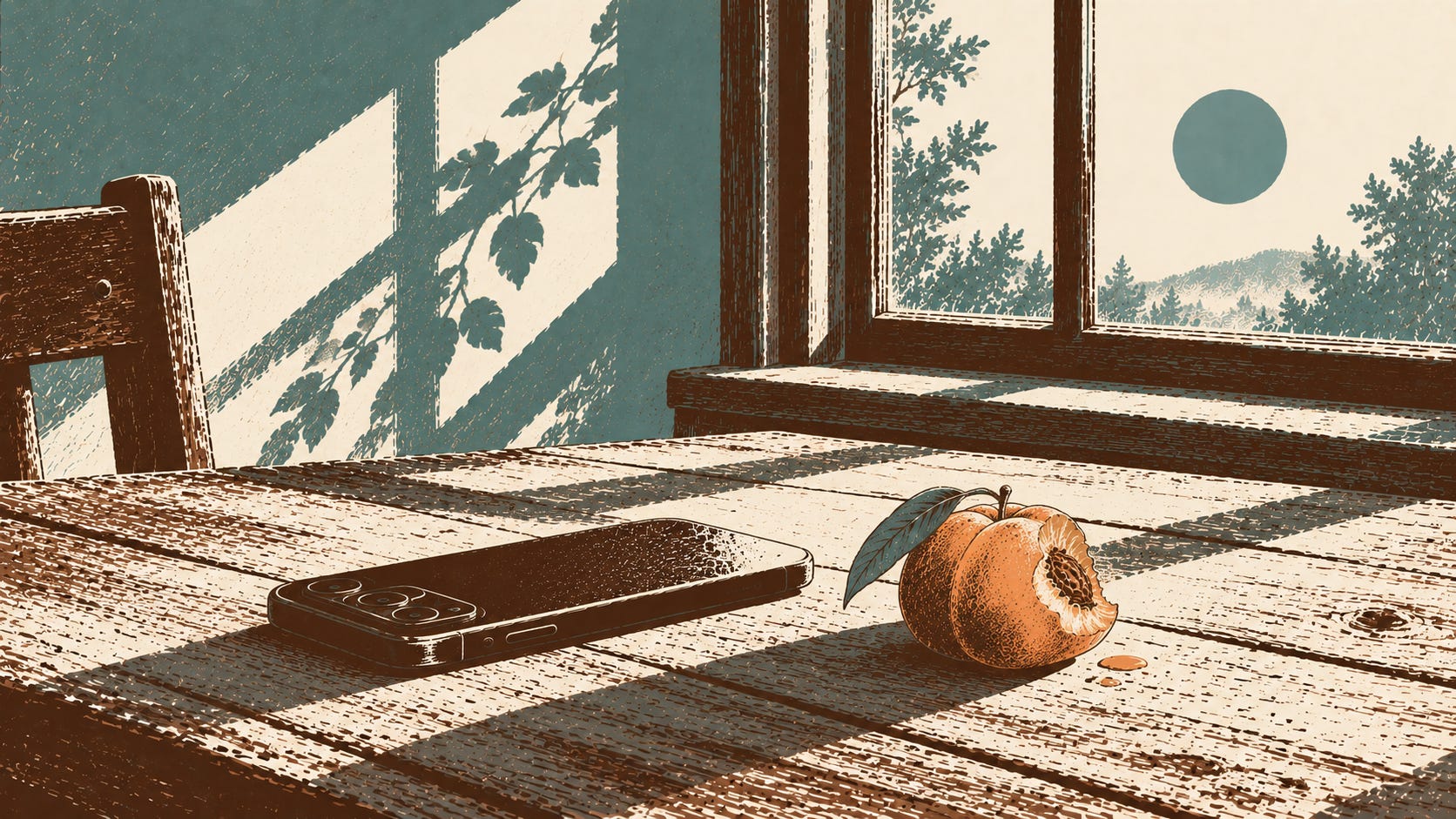
Imagine a kitchen on an ordinary Sunday. It’s just after four, the dishes are drying in the rack, and the laundry is hanging on the line. The kitchen is so quiet you can hear the fridge hum.
Sit down on the old wooden chair, the one with the leather seat and the round brass studs along the edge. The leather is cracked and warm, and it gives a little beneath you. While you sit, let me tell you something.
At a festival in Portugal,¹ a psychologist named Juliana told a story about a desert bird, the gray shrike. All day long he flies over his territory, catching beetles and spearing them on thorns, because the female chooses the male with the finest collection.² Now imagine putting him in a cage with two buttons. One opens the door to the desert. The other brings him a female right away, without a single beetle and without a single wingbeat. Then imagine the second button is rewired, and now it sends cocaine straight into his brain. The bird would press it, again and again, until he forgot to eat and drink. Within ten days he would be dead.³
That seems stupid to us, but it isn’t. His instinct would be doing exactly what it was made for: get the reward and spend as little energy as possible. The desert never had a button like that, so his body never learned when to stop.
The thing in your hand, the one you’re reading me on, is that button. It was built by people who are paid to make you press it two hundred times a day. Your thumb is a healthy, handsome thumb in a strange cage. Juliana drew the difference in two sentences.
Pleasure feels like: This is good, I want more.
Happiness feels like: This is good, I have enough.
Read me to the end. Today I’m the button that leads you out.
The Hand
You lean back, and the leather creaks. Less than ten seconds pass before the next voice speaks up, an older one. The balcony plants need repotting. The tax folder has been lying in the hallway for weeks. Shit, the online course you bought and never started. Is someone who sits here without producing, planning, fixing, or improving anything still worth something? the voice asks. Isn’t this irresponsible? We’ve learned to measure ourselves by movement. That’s why stillness feels suspicious, as if you had to justify it to someone.
Look at your hand as it rests on the table. Look at the lines in your palm and the small scar at the base of your thumb whose story you’ve forgotten. While you sit here, your nail grows a fraction of a millimeter. Who planned your fingerprint? Who repaired the skin over your scar? Who produces the warmth in your palm? Life made all of it, without a meeting, without a deadline, and without a to-do list. Right now it keeps making you, on a kitchen chair, on a Sunday. An old Zen verse puts it like this:
Sitting quietly, doing nothing, spring comes, and the grass grows by itself.⁴
The productivity you worry about comes on its own. Remember the child in front of a pile of Lego, or by the sea with a bucket and spade? Nobody had to motivate her. You couldn’t have kept her in her chair. That child is still in you, waiting for something worth building. Until then, she may sit. Being busy and getting something done are two different things. More work rarely brings more output. It only feels more productive.
Your worth was there before you finished your first task, and it will still be there when you’ve finished your last.
The Fridge
After a minute you get up. You scratch your ankle, open the fridge, look inside, and close it again. You laugh at yourself. See, you think, I can’t even do this. I can’t stand a whole open afternoon.
Nobody can do nothing, not even you, and that’s the good news. Your heart beats, your lungs fill and empty, your hair grows. Try stopping one of them by willpower. Doing nothing isn’t necessarily about sitting still. It’s about taking part: giving your attention to what is happening anyway. Reaching for the fridge, scratching your ankle, and glancing out the window are part of it. That’s doing nothing in motion. Every twitch counts.
The strongest urge to do something comes exactly when you want to sit still. That urge is already the movement. Look at it with a child’s curiosity: where it sits in your body, how it pulls, where it wants to take you. There’s a lot going on in there. That movement is often where creativity comes from.
Three Doors
The treasure chest of doing nothing is huge, and everyone finds a different door into it. I’ll show you three. You can open the first one right now, the others on another day.
The first door is your skin. Sit back down on the old wooden chair, take off your socks, and put your bare feet on the floorboards. Is the wood warm? Is it cool? Feel where your heel rests, where the ball of your foot presses, and how your toes spread a little. Feel, too, how your weight sinks into the leather. The earth pulls you gently down, and the chair holds you up, without you tensing a single muscle. You’re being carried. Your breath goes on by itself, and your skin reports the warmth, the coolness, and the cushion beneath you without being asked. Exactly as it is right now, it’s all right. Stay seated like this for two minutes and let your hands do whatever they want. Watch them.
The second door is your eyes. Light a candle and set it on the table in front of you. For hundreds of thousands of years, people have sat in front of fire like this, in caves, under the stars, and in huts that smelled of smoke and resin. The flame in front of you is the same one, only smaller. Watch it flicker, duck, and rise again, and watch the blue glow at its base. Notice what moves in you while you watch. See whether you can look into the flame and solve a math problem at the same time. Only one of them works. When you catch yourself calculating or wondering what to cook tomorrow, come back to the flame. Instead of a candle, you can use a flower, a bouquet, a small Buddha figure, or a picture that grounds you and reminds you of open space.
The third door is your ears. Listen to the wind, to the rain on the window, or to the sea, if you’re lucky enough to live near it. A mantra, a song, or a singing bowl opens this door too, whichever suits you. You’ll find all of it on YouTube or Spotify: ocean waves, rain in the forest, singing bowls, and mantras, as much as you like. Here the button in your hand becomes a friend. When I started forty years ago, I had to travel far and buy cassettes for things like this, and a singing bowl was almost impossible to find. We live in rich times, and it feels good to notice that now and then.
Make it beautiful. You’re not a monk in a cold cell, unless you like it that way. Otherwise, treat yourself to an oil burner, an incense stick, a soft blanket, and the seat by the window. One reader swears by coffee, water, and a few songs when her brain needs draining. She calls them productive nothing tasks, and she’s right. You don’t have to turn your life upside down for this. Keep it short: two minutes, then a one-minute break, then once more. A little and often carries further than long and rarely. Two minutes a day sounds like nothing. To the dealers at the other end of the button, it makes you dangerous, because people who are awake are harder to steer. Your mind gets used to coming home, like a dog that eventually finds the way on its own. Your thoughts may stay. They just don’t get fed.
Maybe none of these doors fits you because you’re a born fidgeter. Then you’re in good company, because I’m one myself, and an extreme one. I first managed to sit still at nineteen. Until then I had a different door, and on many days I still use it: I do whatever I’m doing anyway, completely. I’ll tell you more about that door later.
The Kitchen Speaks
You’re still sitting on the old wooden chair, bare feet on the floorboards. The kitchen, so quiet a moment ago, begins to tell you things.
In the bathroom the tap is dripping, and every drop lands a little differently. A rectangle of afternoon light has crept across the floorboards, so slowly that you only notice when it reaches the rug. Through the tilted window, a neighbor’s radio is playing an old song you haven’t heard in years. Two peaches lie on the table. You take one and bite into it, and it’s so ripe that the juice runs down to your elbow. For a moment there’s nothing in the world but sweetness and stickiness and the sound of your own chewing.
The silence that seemed empty a moment ago is full of life. All of this was waiting for you here.
Your Sister
In the middle of this silence, your sister flashes through your mind. She’s moving next week, and you haven’t asked whether she needs help. Shit, I have to call her. Your stomach clenches, your thighs tense, and the peach almost slips out of your hand. One more second and you’d be on your feet. Stop. Stay seated for one more breath, the juice on your wrist. You’re the one everyone calls when something breaks: you fix things, you solve things, you keep everything moving. Leaving something alone feels almost irresponsible to you. If I don’t do it, says the voice, nobody will.
You breathe out. The peach is still in your hand, and you’re still in the chair. The impulse came, you noticed it, and you didn’t run after it. That was close, and it feels good.
The hardest part is recognizing when nothing needs doing. Three questions help. Is something on fire? Will it be worse in an hour than it is now? Has anyone asked you for help? If all three answers are no, the matter has time, and so do you.
Sometimes there just isn’t another move to make. A gardener doesn’t pull on the carrots to make them grow faster. When you leave something alone, you trust others with it. Maybe your sister packs her boxes on her own and is proud of it.
If you’re really needed, go, and go all the way. Layman Pang, a family man in eighth-century China, put it like this:
Miraculous power and marvelous activity: drawing water and carrying firewood.⁵
He didn’t do less than anyone else. He was there while he did it.
How can you tell whether your rest is wisdom or avoidance? Before you rush off, feel into your chest, your jaw, and your belly. If your doing nothing is avoidance, something contracts, even if it’s subtle. Your breath gets shallower, something tightens and gets smaller, and a quiet restlessness sits in your stomach. When you’re fully present, it feels different. Everything inside may move, your attention may wander, your body may rest, and nothing has to go anywhere. Your nervous system often knows before your head has found an explanation. Maybe you call. Maybe you text: I’ll get back to you tonight. Trust your body with this.
This kind of doing nothing is creative. You’re giving your unconscious permission to work.
I do things all day too. I’m just there while I do them.
The Cup
Your fingers are sticky from the peach, and the juice has dried on your wrist. You go to the sink and hold your hands under the cold stream. Without thinking, you cup them into a bowl and drink. The water tastes of metal, of your skin, and a little of peach.
Diogenes lived in Athens with almost nothing: a cloak, a bag, and a wooden cup. One day he saw a boy drinking from his cupped hands at a fountain, and he threw his cup away. A child had beaten him in plainness of living, he said.⁶ Water from your own two hands tastes better than water from any cup.
You stand there with dripping fingers and feel light without knowing why. The Brothers Grimm wrote a fairy tale about this feeling. Hans trades his lump of gold for a horse and the horse for a cow, until all he has left is a grindstone, which falls into a well. Everyone thinks he’s a fool. Hans runs home with a light heart and free from every burden.⁷
Maybe Hans knew something we’ve forgotten: you’re allowed to be, without bringing a reason. That goes for him, for you, and for me.
The Bowl
In the evening you eat something simple from a bowl, rice maybe, or soup. Afterwards you stay seated for a moment.
A young monk once came to Master Zhaozhou and said:
I have just entered the monastery. Please teach me.
Zhaozhou asked: Have you eaten your rice?
Yes.
Then wash your bowl.⁸
That’s the whole teaching.
Get up and wash the bowl by hand. Warm water runs over your wrists. The curve of the porcelain is smooth under your fingertips, and the clean rim squeaks when you run your thumb over it. Put it in the rack with the others. Then dry your hands, sit back down on the old wooden chair, rest them open in your lap, and feel them tingle.
What’s next can wait. This is already whole and full.
By the way, I’m sitting too, stroking my chin.
Now put me down, screen side down. The rest of the day is yours.
¹ Juliana Estévez, “Thrill or Fulfill? The Winding Path Between Pleasure and Happiness,” talk at the Liminal Village, Boom Festival 2018: YouTube
² Shrikes really do keep larders on thorns, and females prefer males with larger ones: Reuven Yosef & Berry Pinshow (1989), “Cache Size in Shrikes Influences Female Mate Choice and Reproductive Success,” The Auk 106(3).
³ The cage with two buttons is a thought experiment by psychologist Douglas Lisle, from Douglas J. Lisle & Alan Goldhamer, The Pleasure Trap (2003). It was never run with birds. It rests on experiments with rats: given unlimited access to intravenous cocaine, about 90 percent died within 30 days. Michael A. Bozarth & Roy A. Wise (1985), “Toxicity associated with long-term intravenous heroin and cocaine self-administration in the rat,” JAMA 254(1), 81–83.
⁴ The verse comes from the Zenrin-kushu, a Japanese collection of Zen verses; it is often wrongly attributed to Bashō: Allen Ginsberg on the Zenrin-kushu
⁵ Layman Pang (Pang Yun, 740–808), Chinese lay practitioner and Zen poet: Wikipedia
⁶ The story is told by Diogenes Laërtius in Lives of the Eminent Philosophers, Book VI, 37: text and translation
⁷ Brothers Grimm, Hans in Luck, Children’s and Household Tales no. 83: Wikisource (German)
⁸ Mumonkan (The Gateless Gate), Case 7, “Zhaozhou’s ‘Wash Your Bowl’”: Zen Center of Los Angeles