


Wild & Simple - Stories from an ordinary life, where chocolate and chili dance together.
Hello ,
is this an essay? The word comes from the French essai, an attempt. Montaigne invented the form in the 16th century, and his line about it was, roughly: I myself am the matter of my book. He wrote about his kidneys, his cats, his fear of death, and tested the great questions of the world against them. An essay doesn’t try to give a final answer, it circles a theme. So this is an essay, and I am its matter.
The theme is the soul and coming home. More precisely: What happens when something gets attention for long enough? The silence, the soul, that which sees. When attention no longer goes so much to the outer world, and when it does, then as a mirror, as an invitation that shows how we are in the world, with everything that belongs to it.
What dissolves
Last week I wrote about STAY. In the days after, something in me dissolved. The more attention the listening gets, the more dissolves what my parents and later society called Dirk. I no longer feel any connection to this name, because I was there before.
In 1994, at 24, I had to write a life report during inpatient therapy. The therapists asked us not to write from the mind, but by free association. Back then I saw my own birth and wrote down how I had experienced coming into the world. They didn’t laugh at me, they took it seriously. Only through the writing did I realise that long before Dirk there was something that was I.
This something was never fully gone. It was covered over, and I was maximally distracted by a thousand other, seemingly more important things. Around 2000, one of my most important teachers asked: “What is so important that we forget the most important thing?”
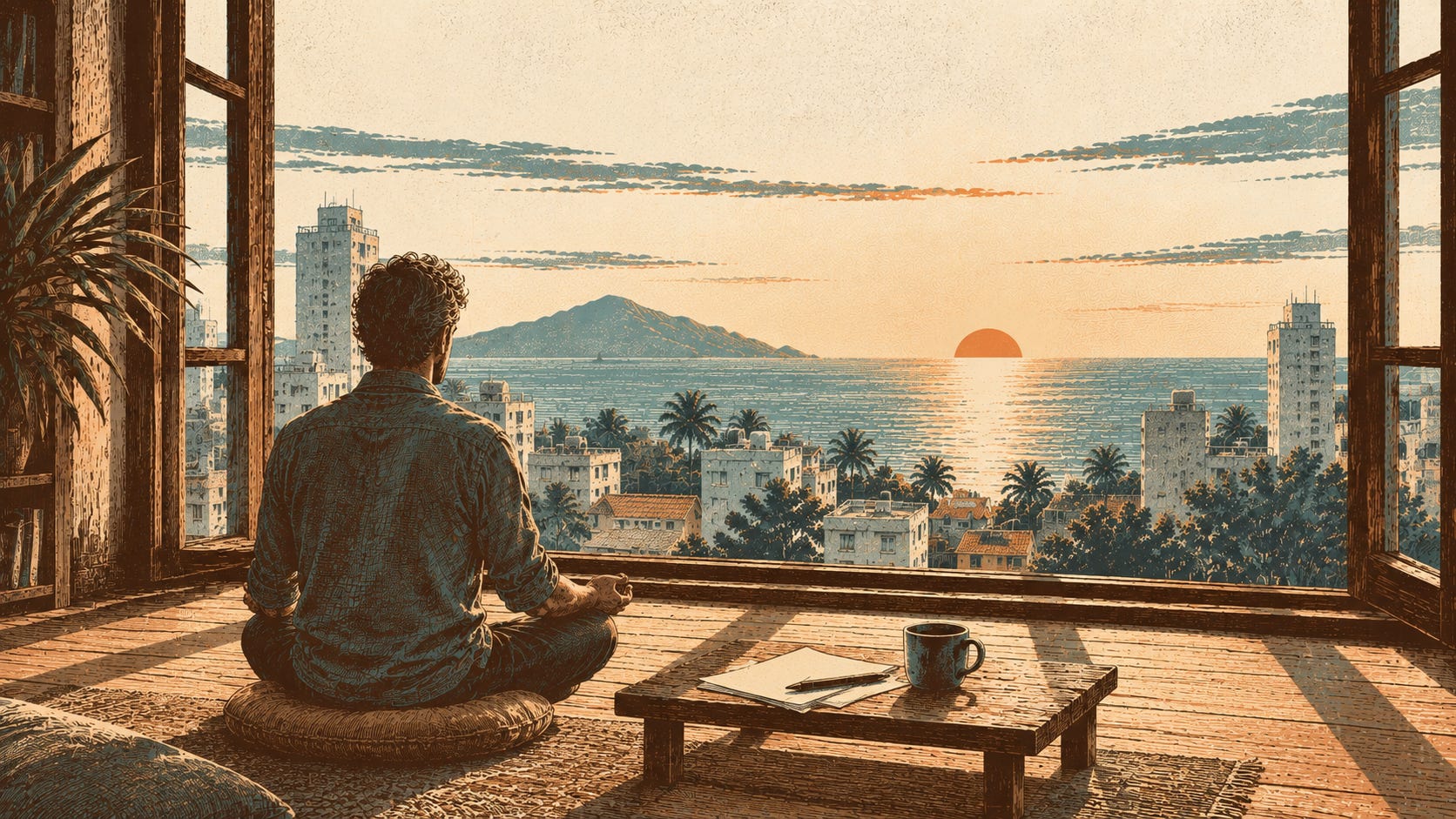
When I leave out the name Dirk and only look at what is and was already there without him, I see colours, dark blue, the soft pink of a cherry blossom, and a name: Shin Li. This figure, perhaps another expression of my soul, was suddenly rediscovered at the end of May 2025 on a train ride in Thailand. First a space opened up in me, and there he sat: an old monk sitting still on a cushion in the middle of the room, who suddenly rose into the air, whirled around, made forms like a kung fu fighter, and finally landed quietly on his cushion again. That obviously had little to do with Dirk and his story.
Dirk is a compressed, conditioned story, a stamp, an imprint. His story has been told what feels like a hundred thousand times, and by now it tastes like coffee reheated for the tenth time. But where Dirk dissolves, Shin Li is still, or already, there. The name came on its own, too, after I had seen the figure. Later I gave my first expression on the internet, an Instagram channel, that name: shinli.writes. Truly an expression of my soul.
A memory, like the moment I rediscovered Shin Li, is a start button, a trigger for further memories. One becomes two, then four, then a whole world, and suddenly you notice that it is everywhere, that you are everywhere. And again and again I simply sit there and listen to the silence.
The word soul
For a long time I couldn’t do much with the word soul. Tibetan Buddhism knows no fixed soul, it takes every self apart, and that suits me very much. It speaks of Rigpa, the nature of mind, empty, luminous and full of an energy that shows itself unceasingly. This energy was always there, it fascinated and accompanied me. I would call it vibration, or frequency.
In India it is called Nada Brahma: the world is sound. A silent piano does not turn into a tone. When someone strikes a string, a vibration arises that becomes audible in the room, and this tone is nothing other than the piano in motion. That is what soul is for me: the first, finest vibration when the silence begins to move. It connects the stillness with moving life, without the two ever being separate.
Today I like the word very much. Not least because people from all directions use it, and every voice touches me in its own way.
What others say about the soul
Heraclitus wrote 2,500 years ago: “You will not find the boundaries of the soul, even if you walk every road; so deep is its ground.”
In the Upanishads, the soul is like the space inside a clay jar. When the jar breaks, nothing joins anything, because the space was never separate.
Meister Eckhart says it from the side of seeing: “The eye in which I see God is the same eye in which God sees me.”
Kabir tells of the musk deer that searches for the scent in the grass, while it carries it within itself.
Rilke hears two strings from which one stroke of the bow draws a single voice.
And Rudolf Steiner has young people speak in a circle: “I look into the world.”
Rumi begins his great work with a flute made of reed. It laments ever since it was cut from the reed bed, and everyone who is far from their origin hears their own longing in its sound. The soul as a tone that wants to go home.
All of these are wonderful expressions of one and the same. That is why I love the variety so much.
What the soul loves
Warm bread, fresh from the oven, the oven built from natural materials and fired with wood, a natural process from A to Z. Butter on it, also organically made. The whole Demeter approach. I have worked on several Demeter farms, and even the way it stinks there belongs to it.
Classical music and every form of artistic expression. Walking barefoot along the beach through the sea. Eye contact and silence. A cat that jumps onto my lap, curls up and doesn’t want to get up again. The dark blue in my Obsidian. The Pieni pen with the thinnest lead I’ve ever had. Eroticism, vibration and tension, maybe that is Nada Brahma too. And patience. My soul loves patience, because then everything sways so beautifully in the mind. Every soul has its own list. Mine smells of a wood-fired oven and a little bit of the barn.
What does not nourish the soul
The neuroscientist Sahar Yousef from Berkeley explains on the podcast Diary of a CEO what happens in the brain. Around a third of our cerebral cortex is dedicated to looking and listening alone. We are built to stay alert to everything that enters our field. When we feel overwhelmed, lonely or anxious, the brain wants to solve the problem, because it is our friend. The fastest and cheapest way is the phone, “a very fast cheap exit to reality”.
Her image for it hits me: we are truly hungry for connection, for belonging, for something new, and we eat Skittles. It tastes good, it shoots up, then comes the crash, and six hours later we look for the next bag. An experiment by the psychologist Timothy Wilson shows how deep this goes: many people would rather give themselves an electric shock than sit alone with their thoughts for fifteen minutes.
Today the bag sits in every pocket. It glows and vibrates. I know the bag. I ate from it for half my life, with substances and without. And I know the bread. Whoever eats it is filled. When I leave out the distraction and reach for pen and paper, for the senses and for books, a space opens up of a quality that amazes me every time. And it is always fresh.
My own experience of soul
When the soul gets full attention, the tears come. At the smallest insights, from deep emotion at the simplicity and beauty of life, and from gratitude.
What hurts comes up too. People I miss, who are far away. For a long time I talked around it, because I was afraid to show myself vulnerable and to allow that I am sad. Now it is different: I think of them, or I tell them that I miss them. And love flows that needs nothing except to express itself.
What I have brought into the world as hurt comes up as well. With it I speak the Hawaiian Ho’oponopono: I’m sorry. Please forgive me. Thank you. I love you. It hurts and is balm at the same time.
And it becomes clear what lay behind all the producing: I have to become something. I have to make an income out of what I am. When I look closely, it is fear, fear of not knowing what tomorrow brings. I can’t sustain anything at all, no positioning, no plan, no brand. That is sad at first, and then an enormous freedom.
A question comes up: Have I ever surrendered? No. It’s not possible. Where would I give myself to? There is only grace, without reason. Life takes things, ideas and identifications from you until there is no ground left under your feet. And still something, or no-thing, is there.
The body listens along. When I sit in Samarpan meditation in the morning, I am almost instantly back on Monte Sobreiro in Portugal, and my palms and the soles of my feet begin to hum. Every time. Why, I don’t know. How do I notice that something does my soul good? By the vibration. It resonates in me like a singing bowl. Everything is still and moves.
What is soul?
I don’t know. An essay doesn’t have to know.
On the podcast, Sahar Yousef asks Steven Bartlett a question that has stayed with me ever since. He is to imagine lying on his deathbed at 110, looking back: What must he have experienced to leave with a smile? Steven sees his children around the bed and a world that has become a little better through him. And Yousef says nobody wishes, there, that they had scrolled more.
I asked myself the question too. Not in search of a purpose, but like this: If my last hour strikes tomorrow, what does my soul really want in this world? The first thing that came: “Wow, what a life that was.” I have truly lived, with all my senses and with everything I had. Making the world a better place is not what I want. I have experienced it as a paradise I was allowed to visit. No writer, no author, no teacher. That is not what my soul is looking for. What it is looking for is this, the writing itself. Wonderful useless.
What it wants is simple: Listen until the text appears, there is nothing more to do. Be a well others can drink from when they are thirsty. Listen and share. This text is a kind of buffet. Take what tastes good to you and leave the rest.
Outside my window it is loud, hammer, angle grinder, concrete drill. Online it is loud too, many voices pulling and wanting. For a long time it was hard for me to stay with myself there. Now I stay. Inside me it is quiet, whatever the circumstances outside.
I was never gone. Shin Li was at home here all along, waiting. He is an expression of my soul, like everything else. I didn’t make him up. Dirk wasn’t looking for anything, Shin Li simply appeared, as a name and as a figure. Maybe as a tool, so that I would recognise myself again. No idea.
Novalis said it in one sentence:
“Where are we going? Always home.”