

Your brain has already decided.
Up to seven seconds before you have the impression that you’re choosing, the signals are measurable. This isn’t esoteric talk. Max Planck Institute, Nature Neuroscience, 2008. The researchers could predict which button a subject would press before the subject themselves knew.
And the daily decisions?
65 percent aren’t consciously initiated.
88 percent run on autopilot.
University of Surrey, 2025.
You think you’re running your life. Your nervous system is running you.
Now the question:
Who wrote the script?
The costume is not your skin
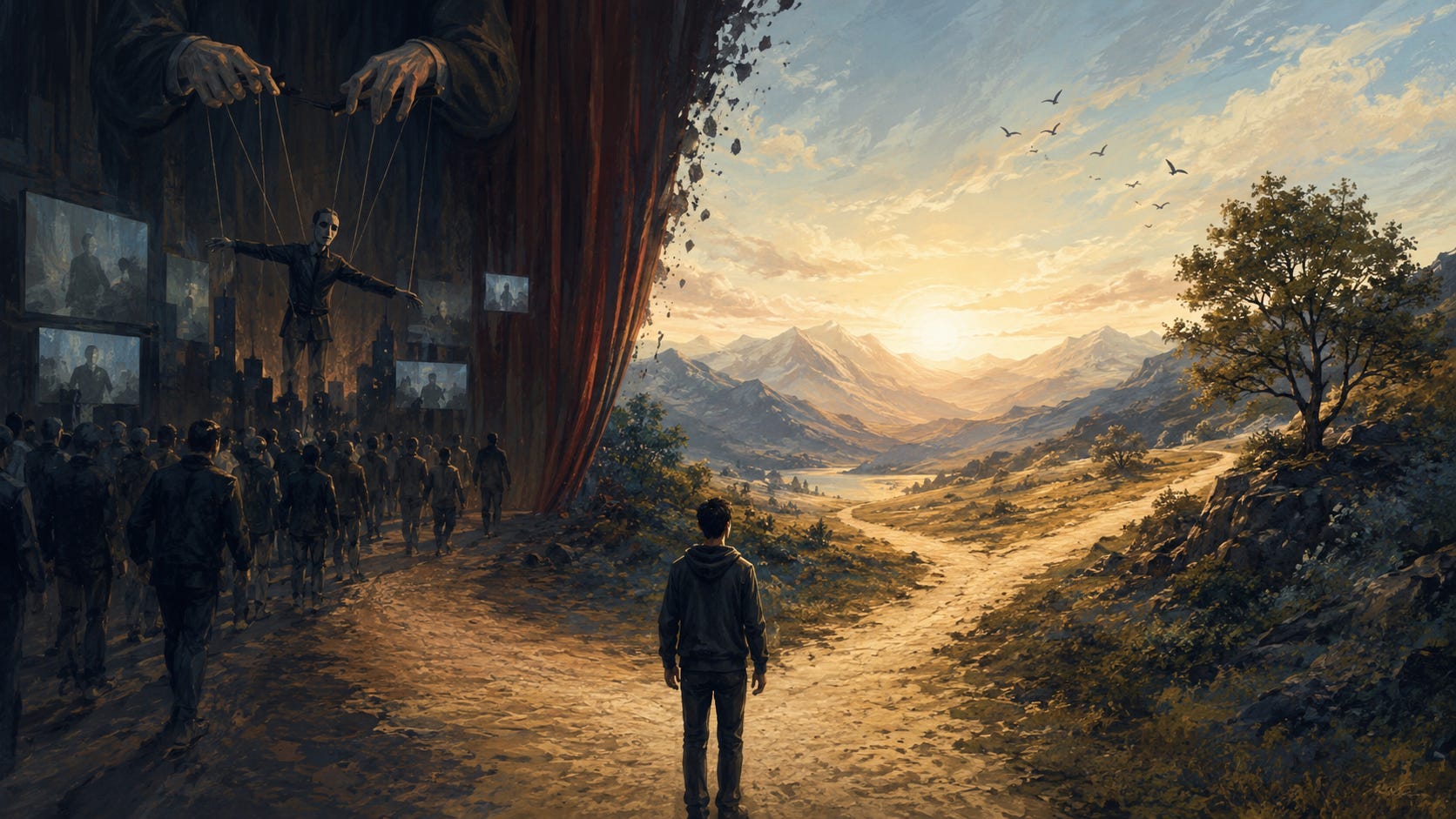
You put it on. At some point. The costume, the role, the lines. You learned them, you delivered them.
Applause. Repeat. Applause.
At some point you forgot you were acting.
The costume became skin. Someone else’s lines became your voice. You’re on stage, the audience is long gone, and you’re speaking words someone else wrote.
The problem isn’t that you’re performing.
The problem is: you no longer know how to exit the stage. Because you no longer know who you are without the character.
You’ve felt it somewhere. An itch beneath the costume. A question that wouldn’t stay down.
A crack.
Story and encounter
Two forces are at war here, and almost no one names them.
Story. The sentences you never wrote. “Success.” “The good life.” “Enough.” The grammar was fixed before you could speak. Your parents, your teachers, the first groups that took you in — they all contributed to this script. You use these words every day without questioning them. Until one day you stop mid-sentence and think:
These aren’t my words.
Encounter. No theory. No concept. The moment you look the hole in the sidewalk in the face and recognize it as yours. Not the story about the hole. Not the explanation for why it’s there. The hole itself. Directly.
C.G. Jung put it this way:
Until you make the unconscious conscious, it will direct your life and you will call it fate.
As long as you don’t see what’s steering you, you call it fate.
Encounter means: seeing it.
Why we stay in costume
Three guards keep the prison locked. None of them wears a uniform.
First: The illusion of choice.
We mistake conditioning for personality. “That’s just how I am” isn’t character. It’s a tape on repeat. If your brain knows what you’re going to choose seven seconds before you do, then who chose? The thought you take for your own is often just the fastest reflex of a story that was there before you were.
Second: Fear as the magician.
Fear is not the problem. It’s the door. The actor feels the costume beginning to loosen. The first reaction is groundlessness. Shame. Failure. The reflex: reach. For the nearest anesthetic. Brain afk.
Fear says: “Don’t go in there.”
The magician says: “That’s exactly where the entrance is.”
Third: Systems built on dependency.
It starts with parents who lay a template over the child before it can reveal itself. It continues in every job, every ideology, every self-optimization loop. The system has nothing against your freedom. As long as you exercise it inside its scenery.
A night I didn’t come back from
I was 18. I took psilocybin mushrooms and thought they’d be like beer or schnapps.
They were the opposite.
Until that moment, the curtain was closed. I had sensed what was behind it, subtly. A contraction in the solar plexus. A pulling. But I had numbed it. After the mushrooms hit, the scene flipped. I was no longer the spectator. I was the stage.
No curtain. No separation. Pure hell. A battlefield. Every belief I had ever believed, suddenly live and embodied.
“You’re not good enough.”
“You’ll never be enough.”
“You don’t belong.”
Every sentence a physical blow.
What followed was weeks. Months. Psychosis. High-proof alcohol every day, to stop feeling what wouldn’t stop being felt. Multiple attempts to end my life.
But there was something I had understood that night: This life you’re looking at, you can’t take it. It’s not the body. This hell doesn’t die.
And then, one night, the first night clean:
“Leave the glass. Let go. Give up. You’re ready now.”
I surrendered.
Everything inside me imploded. My nervous system compressed itself so completely that it burst. What remained: space. Vastness. Absolute knowing and not-knowing at the same time.
Now comes the sentence I hear most often:
“That worked for you. But I didn’t have a psychosis. I just have a quiet unease and a mortgage.”
I understand it. I’ve thought it myself.
The difference between your story and mine is volume. Not pattern. Your reaching is scrolling, working, the next relationship, the next self-optimization program. Mine was alcohol and psychosis. Same mechanism. Same hole in the sidewalk.
And I still reach. Just more subtly. That’s part of the truth too. I’m not the one who’s past it. I’m the one who now recognizes the hole when it appears. Most of the time.
Same hole, different street
Sogyal Rinpoche painted a picture I’ve never been able to shake:
I walk down the street. There is a deep hole in the sidewalk. I fall in. I am lost. I am helpless. It isn’t my fault. It takes forever to find a way out.
I walk down the same street. There is a deep hole in the sidewalk. I pretend I don’t see it. I fall in again. I can’t believe I’m in the same place. But it isn’t my fault. It still takes a long time to get out.
I walk down the same street. There is a deep hole in the sidewalk. I see it. I still fall in. It’s a habit. My eyes are open. I know where I am. It is my fault. I get out immediately.
I walk down the same street. There is a deep hole in the sidewalk. I walk around it.
I walk down a different street.
This is the gift.
Not enlightenment. Not “everything is fine.”
Agency. Options. You see the contraction coming before it has you. You recognize the trap, and you have a choice. Not always. But more and more often.
The 65 percent don’t have to be yours. 88 percent autopilot isn’t god-given. It’s trained. What’s trained can be unlearned.
From MUST to YES.
The story didn’t write you. It only pretended to.
For those who want to go further
SELF / AUTHORED is not a new role. Not a better costume. Not a system that tells you what to believe now.
It’s an invitation to find out what you’re actually choosing. And who you are when you stop performing.