


I was about to write something, and then it was gone.
I’m lying on the bed, the iPhone in my hand, the cursor blinking in an empty line on the screen as I set it down to my left.
The old brown wooden door to the balcony is open. The first light is here, it’s warm, and it’s drizzling.
I close my eyes. My chest rises and falls.
Across the way a bird is singing. I know where it lives, because yesterday I filmed its aviary, a fenced-in balcony full of branches and plants. It sounds like a small parrot, free and melodic, as if it were making up each melody in the very moment it sings it. Apart from the bird, there is nothing to hear.
I don’t chase after what I’ve forgotten. I listen.
With every note my breath grows deeper. The space around me widens, slowly, like air escaping from a balloon and spreading through the whole room.
In my solar plexus something opens toward my back, and out of nowhere an energy rises and pulls at me like an invitation.
There was a time I would have looked for a method to pick up the thread again quickly.
Not today.
The Trapdoor
Now I recognize what is opening in my solar plexus toward my back: a trapdoor, slowly swinging open. Something is rising from down there.
The natural impulse would be to slam the door shut and run, to look for a method, to distract myself, to do anything at all, just not this.
What is rising is neither a feeling nor a thought nor anything else that can be clearly defined. It is old, unknown, unfinished and chaotic.
I see it and experience it as fog, and I sense that this fog stands for everything in me that isn’t smooth: the halfway, the crooked, what I can’t explain and what is always there anyway.
For most of my adult life, my response to this fog was to avoid it.
I have to be perfect. It has to be perfect. Me or it or you, someone is always not good enough, whichever way, as long as it’s not good enough.
These sentences aren’t from me, they’re only in me.
I swallowed them like pills or alcohol or any other kind of numbing, because the longing for the fog was enormous. As soon as the trapdoor opened and the fog drifted in, I either attacked it, my favorite method, or I fled, into pleasure, into numbness, or into projects.
Down there, I thought, lies the land that proves I’m not enough.
The Method
Method sounds harmless and smooth, like a sweet old lady I want to help across the street.
In the end she’s the one leading me across the street, away from the fog, and she talks the whole way:
“Here’s a technique for your restlessness. A system for your thoughts. A routine that turns the unfinished into something finished. A pill would help too, I’m sure.”
I can’t say no.
“Come on, Dirk, you don’t have to go down there. You don’t have to listen. You just have to build, you know? Could these eyes lie? Look how much experience I have.”
I spent years like this, and whenever it turned foggy I didn’t keep still, I reached for the glass, the place, the plan, the next idea I could touch and measure. It worked – for a while. I became faster, more respected, more attractive, and at the same time smoother, sadder and more full of longing.
Only now do I understand the strange part: the more I built, the further I drifted from what wants to express itself through me.
The fog was never gone; it waited patiently. If I had seen fog in you, I would have attacked you, subtly.
Every time I shoveled it over with a new method, it came seeping back through every crack at the next occasion, foreign and threatening.
The hunt itself became the driving force, its prey was the finished thing, and the more I hunted, the less could come into being.
I thought it came down to my lack of discipline and that I just had to do better, be neater, more consistent. That isn’t true. The mistake was never that I didn’t build enough, didn’t try hard enough, or lacked discipline.
The mistake was believing that building is the only movement that counts.
The Ruin in Me
Someone knocks from below on the trapdoor I have always held shut, and says: We have an appointment.
This time I don’t get up.
Very slowly the trapdoor dissolves, first at the edges, then the wood, then the opening itself, until there is no door anymore, only a below.
I fall like a feather that takes its time, and sink slowly, drifting a little from side to side, into another world.
Below me waits what rose up through the door earlier, the fog I have avoided all my adult life.
Now I am in the middle of it.
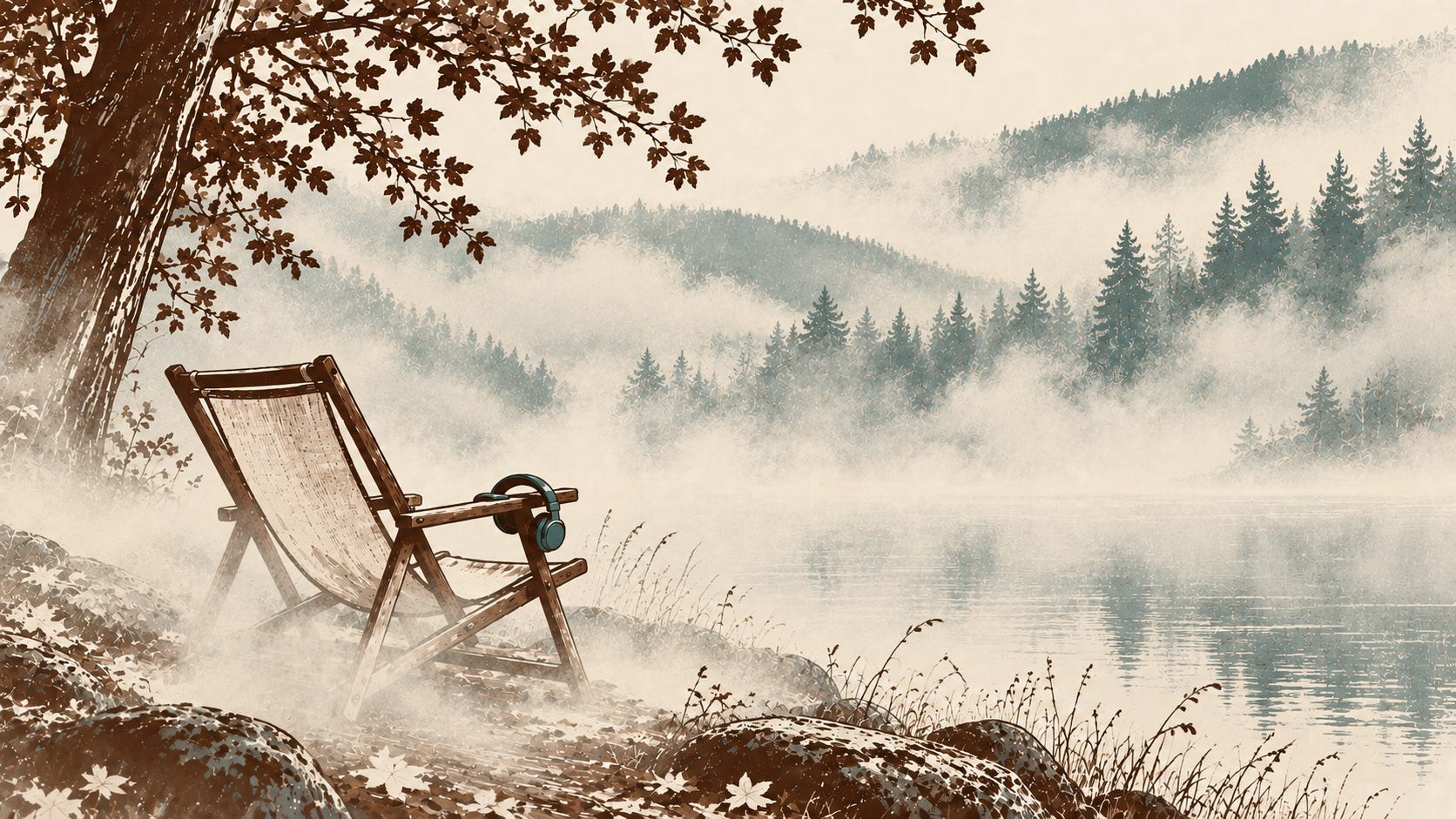
Trees emerge from the fog, dark and heavy with autumn. Behind them a steppe opens up, its grass moving, and in the middle lies a lake with the fog resting on its water. It’s a little gloomy here, and autumnal, but everything is alive.
I land softly on the shore.
My impulse is clear: if I’m here anyway, I might as well make myself comfortable. I take a deck chair, set it down by the water and lean back into the fog.
Breathe in fog. Breathe out fog. That simple.
After a while I put on my headphones, the smooth, dark blue AirPods Max.
My smoothest device, as a door into the unbuilt.
The song is The Birth and Death of the Day, by Explosions in the Sky.
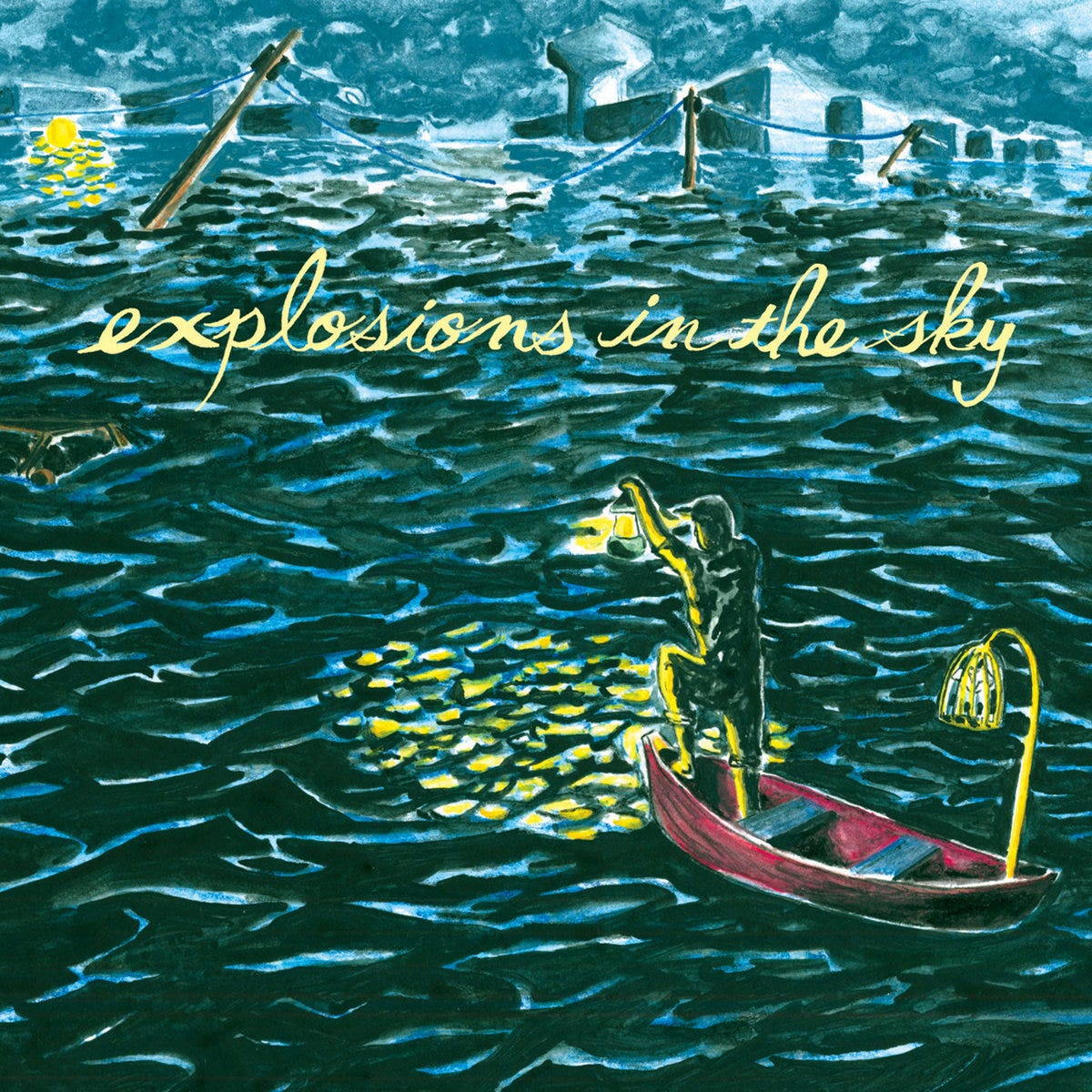
The first notes are a distorted guitar, and even as they swell, the deck chair dissolves beneath me, the way the trapdoor did. First the weight I’m lying with disappears, then the lake, then the body that notices all this. What remains is neither eye nor body, only something that vibrates. A dream body, perhaps. A field of vibration.
I am no longer looking at the scene. I am the scene.
I can’t see anything yet. I am as if blind and at the same time more awake than I’ve been in a long while. And I already know what is here before it shows itself.
Then it spreads. Beneath me, out of me, into the space. And now I see it.
A Scandinavian forest, endless in every direction. There must have been a fire here. The trunks stand bare and charred, and the ground beneath them is dead. Nothing crawls, nothing moves. It smells of cold ash, and at the same time the air is wet, because fog hangs between the burned trees, heavy and thick, and never ends. There is no color, only black and white and all the grey in between. It is dark here and melancholy and familiar in a way I can’t explain, as if I had been here before.
Something crackles in the air.
Two vibrations run through me, one laid over the other. One is calm and even like the needle of a seismograph while the earth sleeps, and it carries me. The other swings so wide that the needle nearly jumps off the paper, and it pulls at me like a magnet pulls at iron. Neither cancels the other out.
Nothing here is near, nothing is far, and between me and the trees there is no longer a single meter anyone could measure.
Something grows out of this grey, again from below and again out of me: a blade of grass.
I am this blade of grass, fine and tender and without color, only form, in the middle of this dark world, and I feel myself growing. The sounds of the guitar push me back and forth, and I give way, bend further than a blade of grass should be able to bend, and come back. Every note is gasoline.
Note by note the sounds of the guitar grow denser, and the energy in the blade of grass draws in on itself. The fog begins to shimmer, and the crackling in the air grows louder. The dead trunks stand still, but it is the stillness of something holding its breath. The whole forest seems to know something I can only sense.
Minute 4:34.
I had never heard the piece before. And yet I had sensed it.
God built TNT into me.
It tears me into millions of tiny pieces, and everything turns to slow motion. The tears come at once. I expand like the Big Bang, like a firework above the black-and-white forest, and watch the particles drift slowly between the trunks, through the fog, further and further. I am the TNT, and I am the space it flies into. Everything melts together, everything dissolves.
Into the middle of this dissolving, a voice speaks. It doesn’t belong in this forest, it is distorted and speaks English, and it takes a moment before I recognize it: it’s Siri, telling me my sister is calling.
I laugh from the bottom of my heart. Another cosmic joke.
The image stayed anyway. Since then the forest is there whenever I close my eyes, still black and white, still without a single color. But it is no longer dead. Worms move in the soil, something is growing back between the trunks, there is movement everywhere.
I am no longer the blade of grass, I am a wolf. Without a single thought I run between the burned trees, savoring and exploring every millimeter with my nose and my instincts.
The forest is alive.
With my nose to the burned ground, I recognize the pull that drew me here.
I have always stopped in front of ruins, old walls, collapsed roofs, stonework with grass growing from its cracks, and every time something pulls me in.
This forest pulls the same way.
Only it lies within me.
What I attacked or numbed for most of my adult life, the crooked, the halfway, the unfinished, is not a defect. It is the source of everything that was ever truly mine.
Building and Listening
At some point I hang up, and when I unlock the iPhone, the cursor is still blinking in the empty line, as if it had been waiting.
None of what I just lived through could I have built. And yet it was two smooth devices that led me in and brought me back out, the headphones and this iPhone.
So the finished isn’t the problem. A mirror-smooth lake is beautiful, and so is a completed work. The headphones were the door, but they were not the forest.
The problem was that I only saw this one side anymore. Yin and yang are two, and I lost one of the eyes. Everything that wasn’t smooth or measurable, I treated like a malfunction that needs fixing. Not like the other half, the one that wants to be heard.
And I had it backwards. I thought first you build, and then something comes into being. But listening comes first.
And I can only listen alone. The forest was there as long as nobody wanted anything from me. It took one phone call, and the journey was over.
I’m not the first to notice this.
Kafka wrote to Felice that one can never be alone enough when writing, that there can never be enough silence around one:
“Even the night is not night enough.”
Rilke advised the young poet to love his solitude and to bear the pain it causes him. For me, that means staying seated in the fog instead of driving it away.
In 1932 Picasso told a Madrid newspaper over the phone:
“No se puede hacer nada sin la soledad.” – Nothing can be accomplished without solitude.
And Machiavelli, banished from Florence in 1513, spends his days in the village tavern, playing cards and squabbling over pennies. In the evening he takes off his dirty clothes, puts on festive ones and goes into his study. There he speaks with the ancients, and they answer him. For four hours, he writes, he feels no sorrow, forgets his poverty and does not fear death.
In How Multi-Passionate Writers Paralyze Themselves, Philipp describes what it costs when you can no longer follow someone else’s plan: “There is no crowd to protect you. You have to stand fully by yourself, and that’s pretty scary.” He calls the power that gets released creative force, and he says we already have the raw material.
This text is my addition to his, told from the inside. This is what it looks like for me when I’m alone and don’t run away. I believe the source of that force lies here, in the fog.
The Invitation
I’m not giving you a method here. You know why by now.
Why I tell you about it anyway, I learned in a sweat lodge. It was pitch-black, I was sitting bare-assed on the grass, and there I found out how healing it is when someone starts to share instead of hiding.
Right now I’m sitting here writing this text, and that is building, sentence by sentence. Only this time the material comes from below.
The next time it turns foggy in you, you don’t have to run. You’re allowed to sit down in it. I’m there when you’re there.
I always thought that down there lay the land that proves I’m not enough.
Down there is a forest.
And it’s alive.